The search for life beyond the Solar System increasingly comes down to one practical question: how many observations does it actually take to spot a chemical trace of biology in a distant planet's atmosphere. A new study gives a numerical answer for one of the most anticipated instruments of the coming decade.
The instrument is the Extremely Large Telescope (ELT), currently under construction in Chile, together with its spectrograph ANDES, which will operate in the visible and near-infrared range at high spectral resolution. A team of astronomers built a simulation-and-detection pipeline to test whether this combination could distinguish carbon dioxide, water, oxygen, and methane in the atmospheres of Earth-like rocky planets.
Bayesian cross-correlation instead of simple signal counting
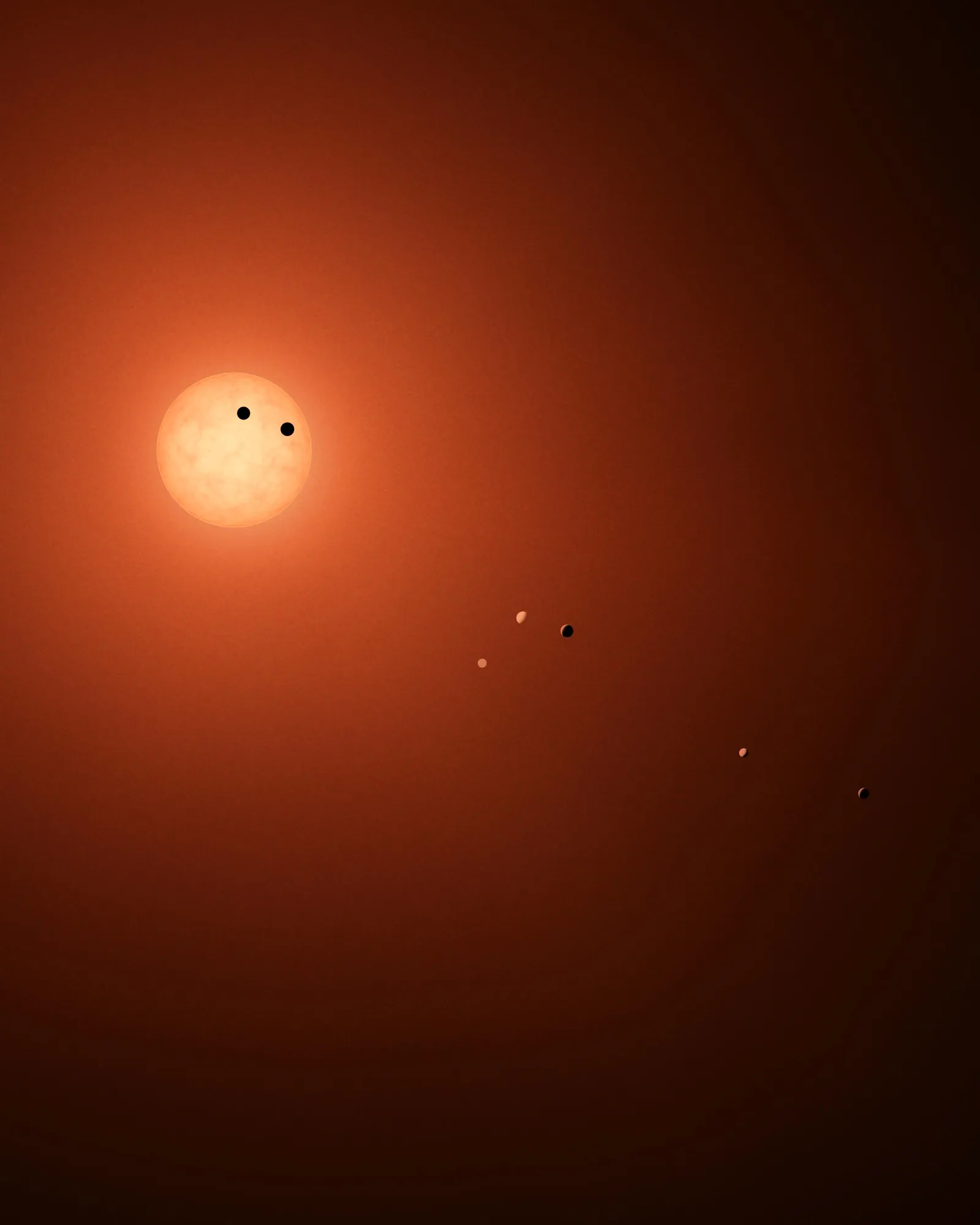
The observing technique is transmission spectroscopy. As a planet crosses in front of its star, part of the starlight passes through the planet's atmosphere and gets absorbed by gas molecules at specific wavelengths. These absorption "dips" in the spectrum form the chemical fingerprint.
The catch is that at distances of tens of light-years, the atmospheric signal of a rocky planet is extremely faint and easily buried in noise. The authors introduced a new Bayesian cross-correlation function (CCF) framework, using molecule-specific kernels and an autoregressive model that accounts for correlations within the signal itself. Noise estimates came from the ANDES Exposure Time Calculator in seeing-limited mode — that is, without adaptive optics, accounting for realistic atmospheric interference.
A detection was considered decisive when a statistical measure (the log of the Bayes factor) exceeded a threshold of 2.0 — a fairly conservative criterion designed to rule out chance coincidences.
18 planets, and a different price tag for each molecule
The team applied the method to 18 known potentially habitable transiting exoplanets. For each one, they calculated how many transits would be needed to confidently detect CO₂, H₂O, CH₄, and O₂.
Water turned out to be the easiest molecule to find. For the TRAPPIST-1 planets, 10 to 19 transits are enough; for LHS 1140 b, about 30. That alone represents a substantial observing campaign, since each transit lasts only minutes to hours and recurs once per orbital period.
Other gases demand considerably more time. Carbon dioxide requires roughly 1.5 times more transits than water. Methane needs about three times as many. Oxygen, the classic marker of photosynthetic life, proved hardest to detect: roughly four times more transits than water.
Ideal conditions as a lower bound on reality
The authors are explicit that these numbers represent an optimistic scenario. The calculations assume cloud-free atmospheres similar in composition to modern Earth's, perfect removal of systematic trends in the data, and a complete absence of instrumental errors. In real observations, clouds, stellar activity, and imperfect detrending would inevitably push the required number of transits higher.
Even under these favorable assumptions, the numbers imply dozens of observations of a single target — meaning years of dedicated telescope time for one planet and one molecule.
That is why the researchers point to an alternative approach: reflected-light observations using high-dispersion coronagraphy for nearby, nontransiting planets. This method does not depend on a lucky alignment between a planet's orbital plane and the line of sight, and could serve as a useful complement to transit-based searches for biosignatures.