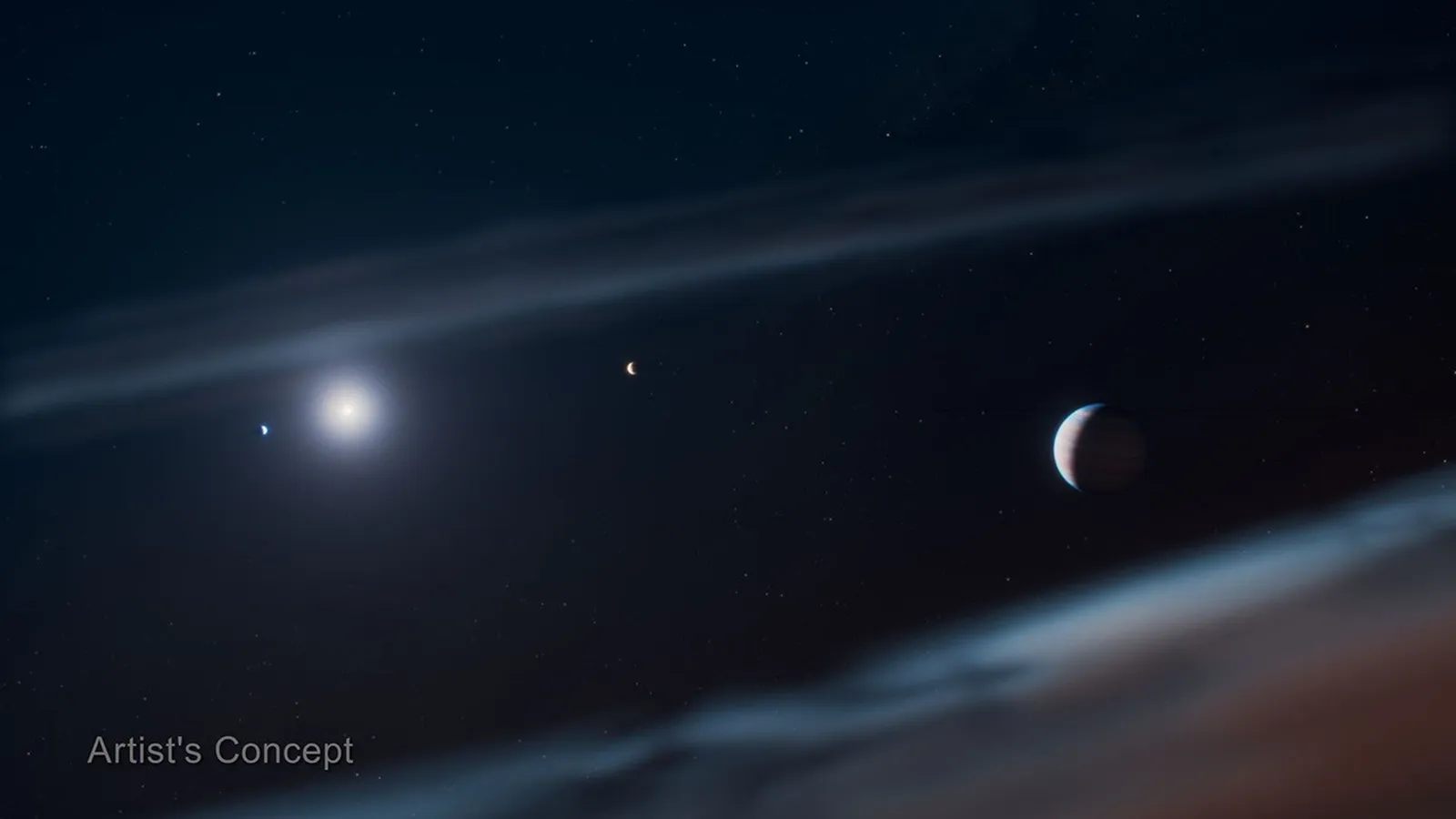
Astronomers have studied the Beta Pictoris system for decades as a textbook example of a young planetary system still taking shape. It seemed to have given up most of its secrets already. The James Webb Space Telescope proved otherwise: a third giant planet was hiding within the star's bright dust disk, found not as a point of light but through the chemical fingerprint of its atmosphere.
The discovery is described in a study published in the Astrophysical Journal Letters. The lead author is Aidan Gibbs, a postdoctoral researcher at the University of California, San Diego.
A third planet in a familiar system
Beta Pictoris lies 63 light-years from Earth and is about 23 million years old — remarkably young by astronomical standards. Two giant planets were already known here: Beta Pictoris b, one of the first exoplanets ever directly imaged, and Beta Pictoris c.
The newly identified Beta Pictoris d is estimated to be at least twice the mass of Jupiter, making it the lightest of the three known giants in the system. It orbits at about 30 astronomical units from the star, comparable to Neptune's distance in our own solar system. That's the widest orbit among the three planets, though it still sits inside the disk's inner edge.
Beta Pictoris is now only the second known planetary system with at least three directly imaged planets.
A signal no one was looking for
Astronomers were not searching for a new planet. The team was using Webb's NIRSpec instrument, specifically its Integral Field Unit, which captures both an image and a spectrum for every pixel, to study the atmosphere of the already-known Beta Pictoris b.
Instead of the smooth spectrum expected from starlight scattered by dust, an odd pattern of peaks and troughs appeared in the data — a distinctive series of carbon monoxide absorption lines, spread out like a barcode, a signature typical of giant planet atmospheres.
Spectroscopy revealed not only chemical composition but also the object's radial velocity. Its speed, position, and alignment with the debris disk were all consistent with a planet orbiting Beta Pictoris, ruling out a background star or a brown dwarf with carbon monoxide of its own.
There was an unexpected bright source of light within the Integral Field Unit imaging, but we've learned not to trust bright blobs in images. They can be instrumental artifacts or other structures in the debris disk. By obtaining a spectrum at the same time as the image, we were able to quickly confirm our suspicions.Jean-Baptiste Ruffio, University of California, San Diego
Follow-up observations with Webb's other instrument, MIRI, made under a separate discretionary time request, detected water vapor and methane in the planet's atmosphere, confirming its identity and offering a richer look at its chemistry.
Spectroscopy cutting through the fog
Beta Pictoris d stayed hidden for years because it sits within one of the brightest known debris disks. Dust in the disk scatters the star's light like fog, making it hard for conventional imaging to distinguish a planet from surrounding structures.
The spectroscopic approach effectively ignores that dust, isolating only the narrow molecular lines unique to a planetary atmosphere, independent of the scattered background light.
Astronomers suggest the planet's presence may explain the disk's sharply defined inner edge and other unusual features in its structure. In fact, a planet like Beta Pictoris d had already been predicted to account for those very anomalies before it was found.
A new way to find worlds
This is the first directly imaged planet found primarily through moderate-resolution spectroscopy rather than classic coronagraphic imaging. The method shows that astronomers can detect planets in complex environments — where dusty disks or bright starlight make direct imaging fail.
A separate imaging study led by Ben Sutlieff of the University of Edinburgh and Markus Bonse of the European Southern Observatory independently confirmed the existence of Beta Pictoris d, using data from the Very Large Telescope (VLT) and Webb's NIRCam instrument.
The team plans to continue analyzing Webb's observations to pin down the planet's temperature, atmospheric composition, and orbit — adding another chapter to the story of one of astronomy's most iconic planetary systems.