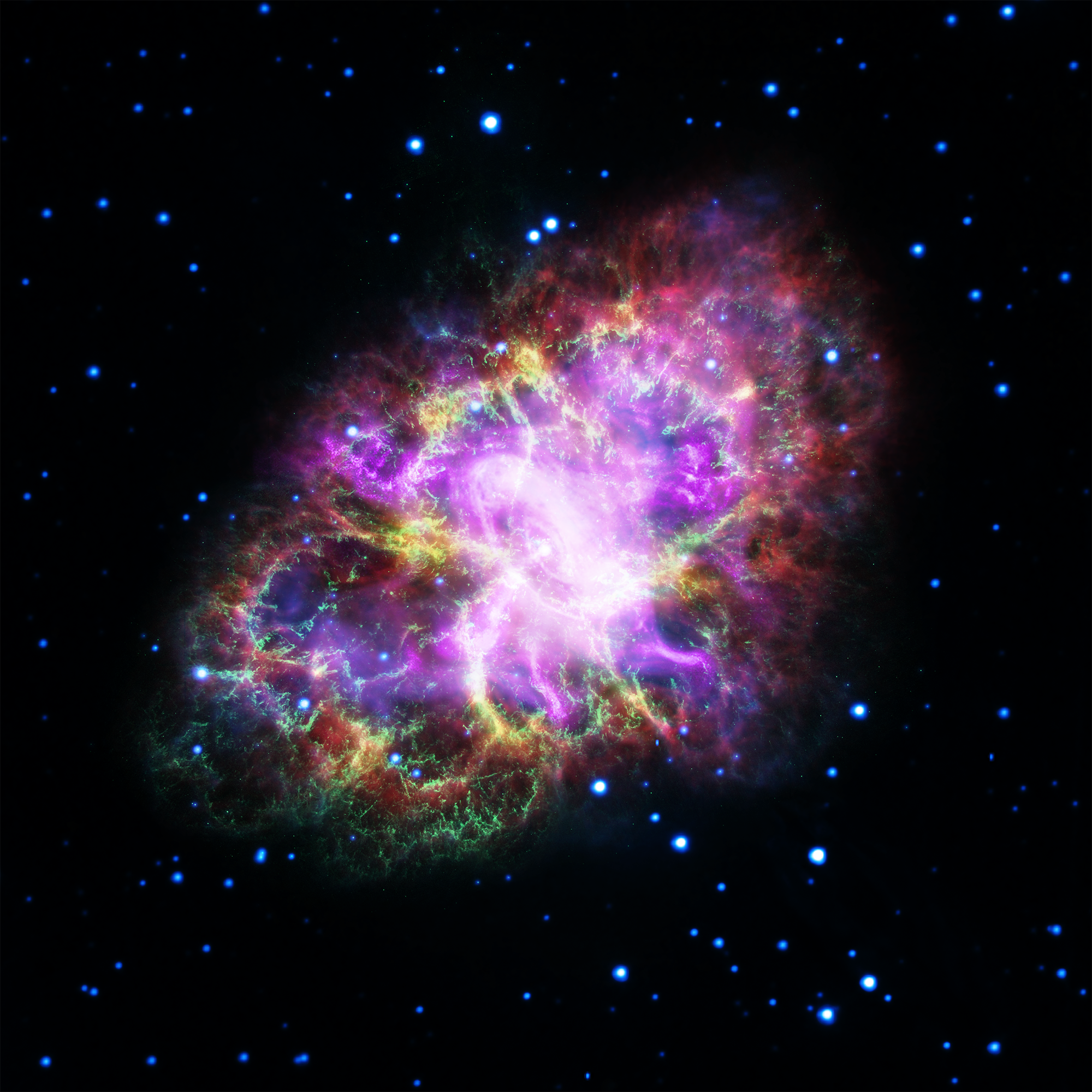
A neutron star is extreme enough on its own. But some of them also spin at insane speeds and shoot narrow beams of radio waves from their magnetic poles. When such a beam sweeps past Earth with each rotation, we see rhythmic flashes — like a cosmic lighthouse. That's a pulsar.
The first pulsar was discovered in 1967 by graduate student Jocelyn Bell Burnell. The signal was so regular that it was jokingly dubbed LGM-1 — "Little Green Men." But it turned out to be no aliens — just a neutron star rotating with astonishing precision.
The fastest known pulsar — PSR J1748−2446ad — spins 716 times per second. A point on its equator moves at ~24% the speed of light. Such millisecond pulsars are among the most precise clocks in the Universe, rivaling atomic ones.
It was pulsars that led Hulse and Taylor to indirectly confirm the existence of gravitational waves in 1974 — earning them the Nobel Prize in 1993. Today, networks of millisecond pulsars (Pulsar Timing Arrays) serve as a galaxy-sized detector — searching for low-frequency gravitational waves from pairs of supermassive black holes.
And one more fact that's easy to miss: the first exoplanets in the history of astronomy were discovered not around an ordinary star, but around a pulsar. In 1992, Aleksander Wolszczan found planets orbiting PSR B1257+12 — a dead star spinning 161 times per second. Planets around a supernova remnant — this really exists.