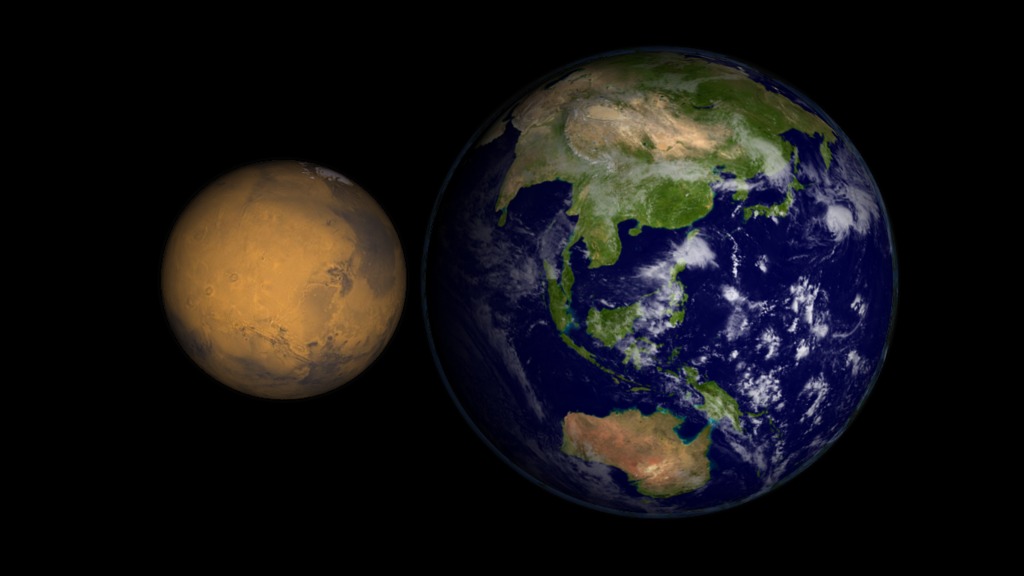
One of the key questions in the search for extraterrestrial life: what's the minimum planet size that can hold onto an atmosphere? A team of researchers built the STEHM model (Smaller Than Earth Habitability Model) to find out.
The model examines rocky planets from 1.0 down to 0.5 Earth radii (R⊕) in the habitable zone of a Sun-like star. Key result: planets ≥0.8 R⊕ can maintain their atmospheres for billions of years under Earth-like conditions. Smaller ones lose theirs.
For context, 0.8 R⊕ falls roughly between Earth and Mars (Mars is ~0.53 R⊕, Venus ~0.95 R⊕). Mars is clearly too small — and we see it firsthand: its atmosphere is extremely thin.
Under certain parameter variations, the boundary can drop to 0.7 R⊕, but this requires special conditions. The most critical factor is initial carbon inventory. Carbon fuels volcanic degassing, which replenishes the atmosphere. However, making a significant difference requires carbon reserves differing from Earth's by orders of magnitude.
The best chances for atmospheric retention belong to planets with large carbon reserves, abundant radioactive elements (heating the interior), cool initial mantles, and small cores relative to overall size.
The model assumes a stagnant lid planet — no plate tectonics like Earth, but a single immobile crust, like Mars or Venus. This is a conservative approach: plate tectonics would likely improve atmospheric retention further.
Practical takeaway: as future telescopes discover ever smaller exoplanets, this model helps prioritize which ones are worth targeting for atmospheric and habitability studies.