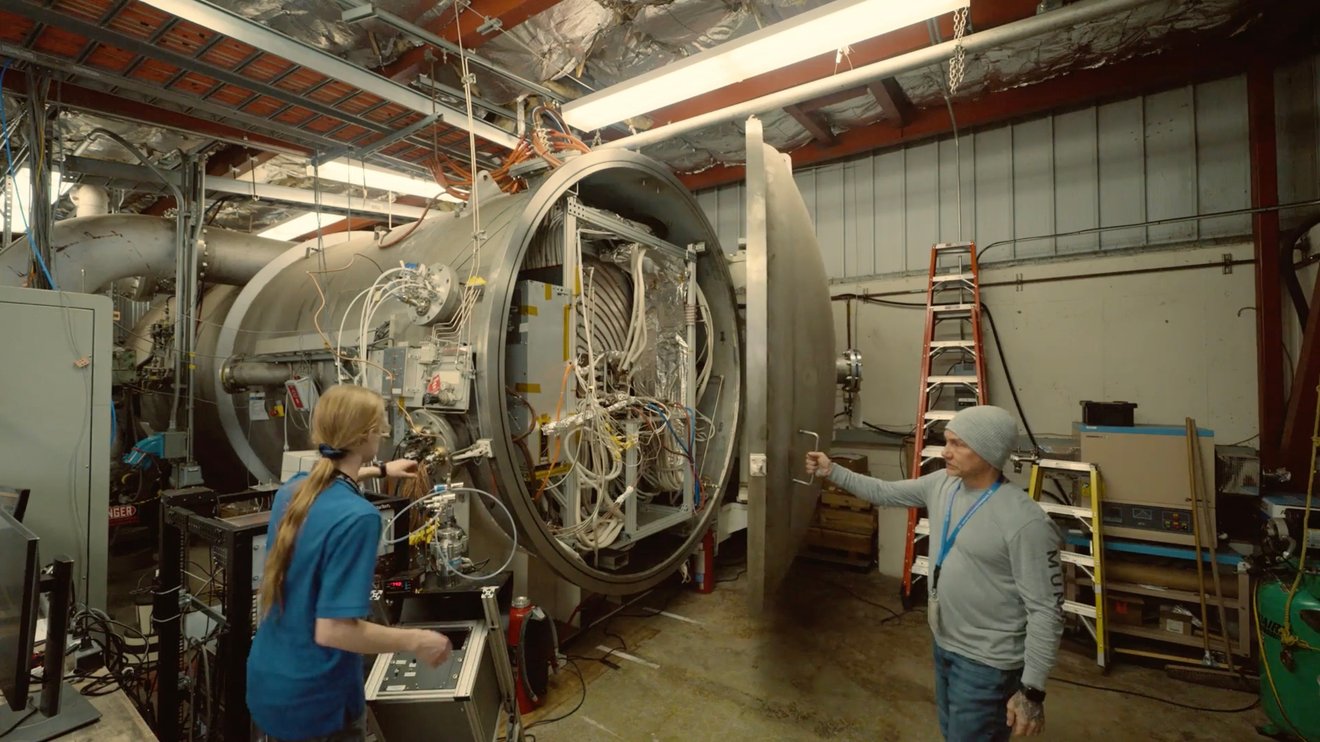
On February 24, 2026, NASA's Jet Propulsion Laboratory fired up an electromagnetic thruster running on lithium metal vapor — reaching power levels of up to 120 kilowatts. This is the highest power ever achieved by an electric propulsion system in the United States, over 25 times more powerful than the thrusters on NASA's Psyche mission, currently the agency's most powerful electric propulsion spacecraft.
The technology is called an MPD (magnetoplasmadynamic) thruster. It uses high electric currents interacting with a magnetic field to accelerate lithium plasma. During five ignitions, the tungsten electrode at its center glowed white-hot at over 2,800 °C, while the nozzle emitted a bright red plasma plume.
Electric propulsion uses up to 90% less propellant than chemical rockets. Instead, it produces low, continuous thrust that builds up enormous speeds over time — Psyche's thrusters, for instance, accelerate the probe to 200,000 km/h.
MPD thrusters have been researched since the 1960s but have never flown in space. The key challenge is durability at extreme temperatures. A crewed Mars mission would require 2–4 megawatts of power, multiple MPD thrusters, and over 23,000 hours of continuous operation. The team's near-term goal is reaching 0.5–1 megawatt per thruster.
Paired with a nuclear power source, these thrusters could significantly reduce launch mass and support the payloads needed for human Mars missions.
The project is led by JPL in collaboration with Princeton University and NASA's Glenn Research Center.