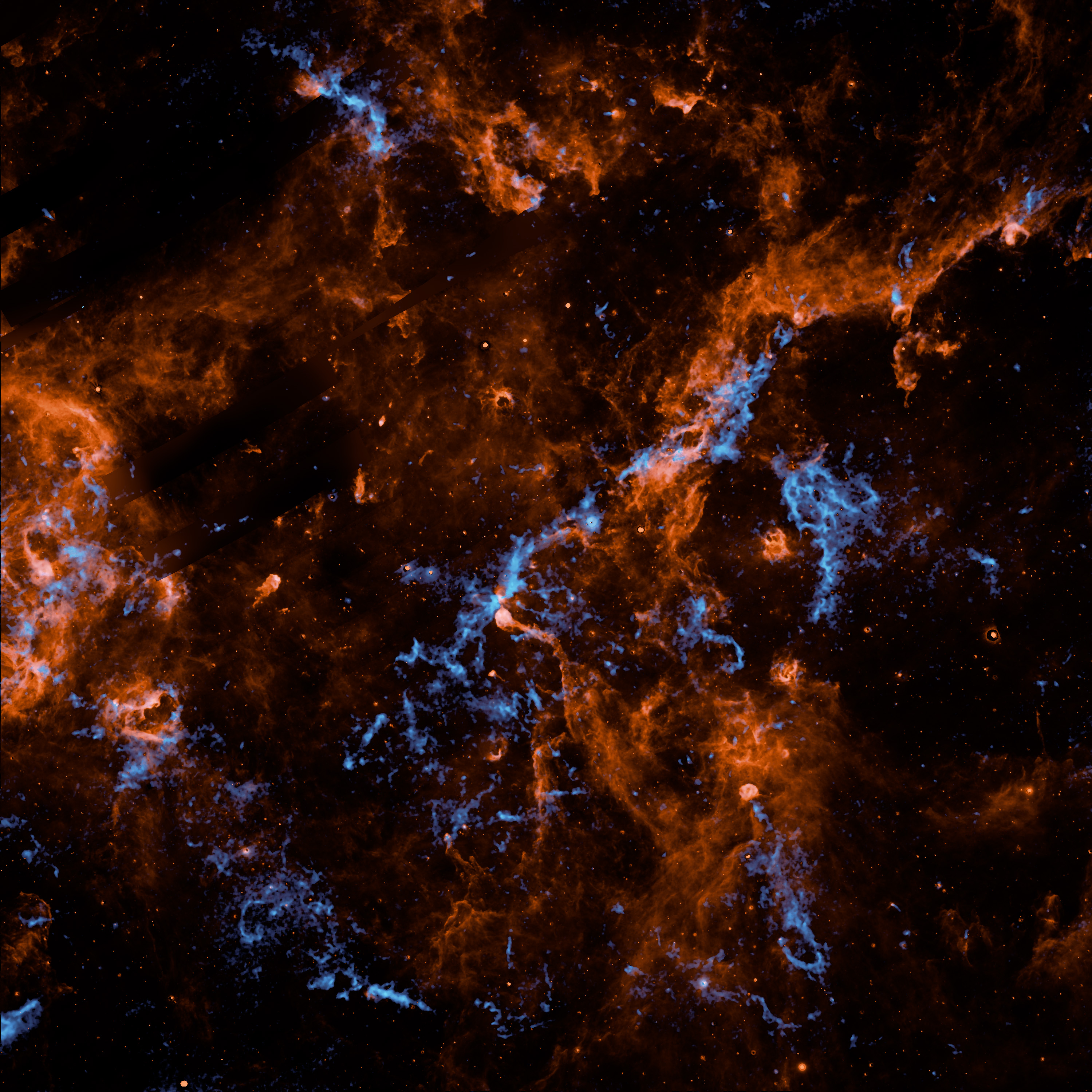
NASA's SPHEREx mission has mapped interstellar ice at an unprecedented scale — covering Milky Way regions over 600 light-years across. The findings were published in The Astrophysical Journal.
The ice sits inside giant molecular clouds — vast regions of gas and dust where dense clumps collapse under gravity and give birth to stars. The ices detected are water, carbon dioxide, and carbon monoxide — molecules essential to the chemistry of life. Researchers believe these reservoirs are where most of the Universe's water forms and is stored. Earth's oceans, the ice in comets, and the ices on other planets and moons all originate from such regions.
The ice clings to the surface of tiny dust grains, no larger than particles in candle smoke. Dense dust shields the ice from the harsh ultraviolet radiation of newborn stars.
"These vast frozen complexes are like 'interstellar glaciers' that could deliver a massive water supply to new solar systems that will be born in the region," said Phil Korngut of Caltech.
SPHEREx (Spectro-Photometer for the History of the Universe, Epoch of Reionization, and Ices Explorer) launched on March 11, 2025. Its unique capability is seeing the sky in 102 colors of infrared light, each wavelength carrying distinct information about galaxies, stars, and planet-forming regions. By late 2025, the telescope had completed the first of four planned all-sky surveys.
Earlier missions like JWST and Spitzer had detected such molecules before, but SPHEREx is the first infrared mission specifically designed to find them across the entire sky. The team studied the Cygnus X region and the North American Nebula, confirming that ice density overlaps precisely with the dark dust lanes.
Three more all-sky surveys are ahead — bringing new answers about how the molecules necessary for life reach young planets.