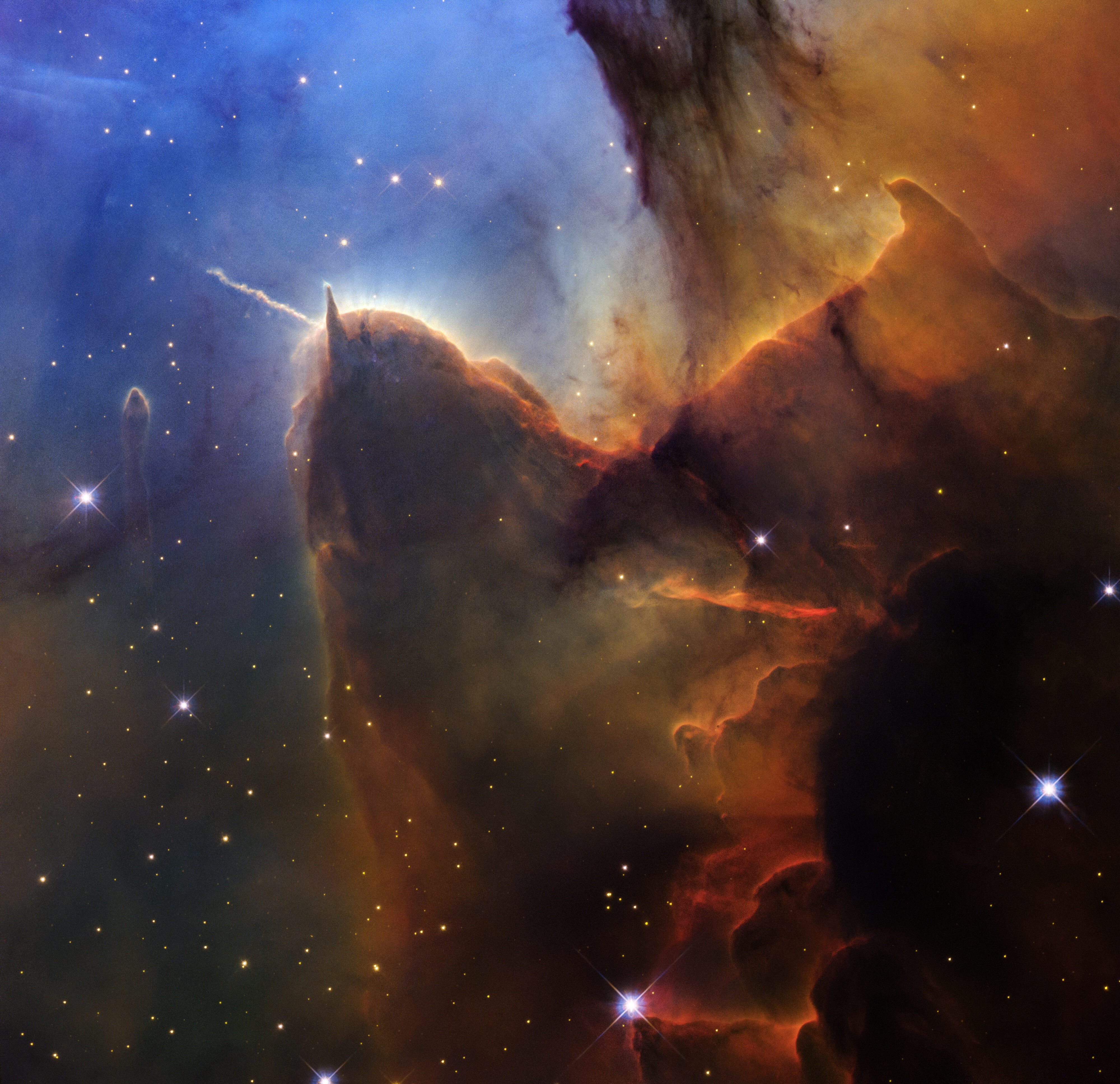
For its 36th anniversary, Hubble revisited a scene it first captured in 1997 — a portion of the star-forming Trifid Nebula (Messier 20) in Sagittarius, about 5,000 light-years away.
Twenty-nine years after the original image, Hubble has captured changes in the nebula on human timescales. This was enabled by the Wide Field Camera 3, installed during the fourth servicing mission, which offers a wider field of view and greater sensitivity.
The image features a gas and dust cloud nicknamed the "Cosmic Sea Lemon." Its left "horn" is part of Herbig-Haro 399 — a plasma jet periodically ejected by a young protostar embedded in the cloud. Comparing with the 1997 image shows the jet expanding, allowing researchers to measure outflow speeds and the energy the protostar injects into its surroundings.
Several massive stars outside the frame have been shaping this region for over 300,000 years. Their ultraviolet winds blow an enormous bubble, compressing gas and dust and triggering new waves of star formation.
Over 36 years of operations, Hubble has made more than 1.7 million observations. Nearly 29,000 astronomers have published peer-reviewed papers using its data — over 23,000 publications, with ~1,100 in 2025 alone.