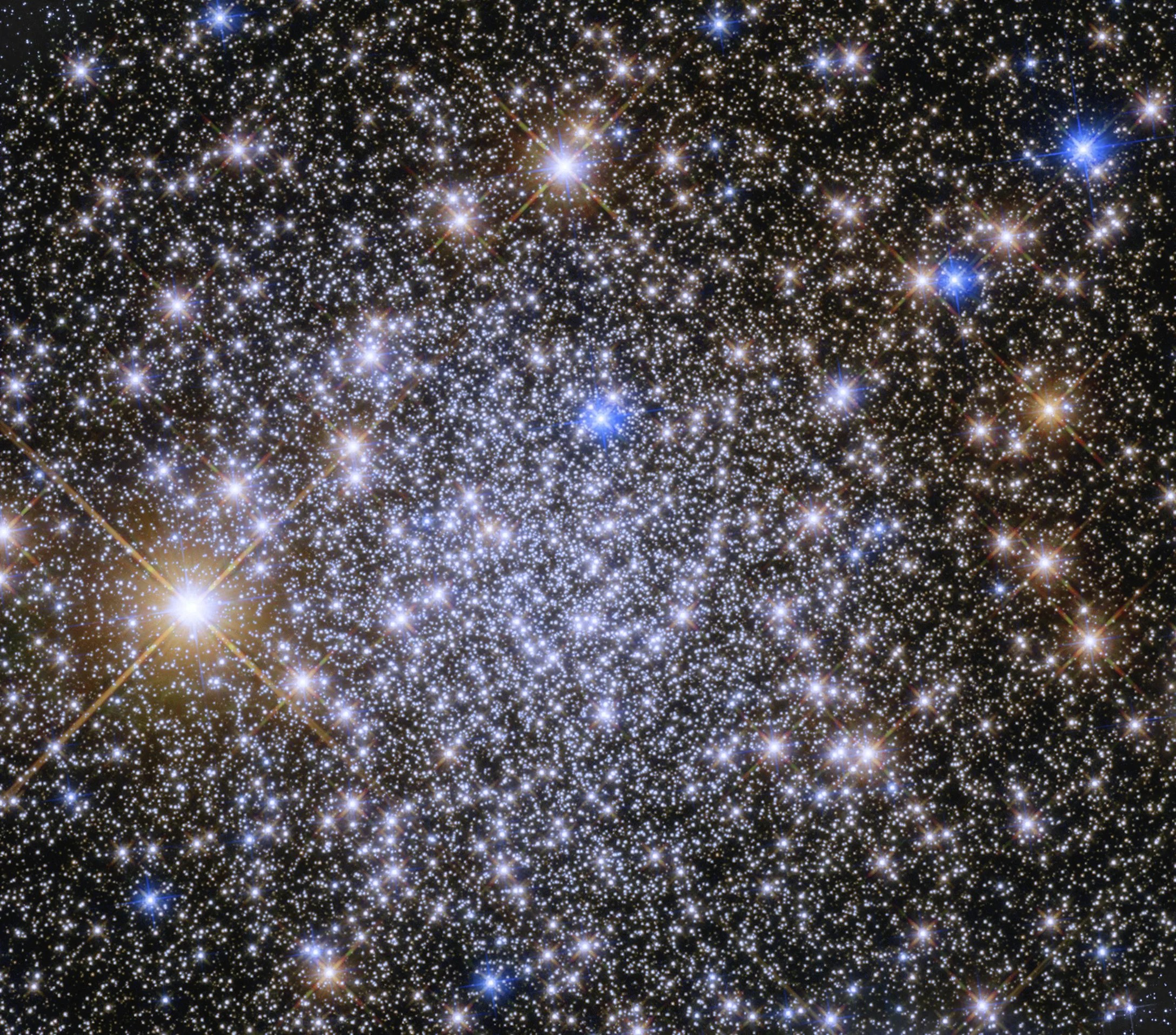
At the center of our Galaxy lies the bulge — the dense "core" of the Milky Way. Its history is deeply tied to the Galaxy's earliest formation, but reconstructing it is difficult: billions of years of mergers and evolution have erased most traces. Among all stellar systems, only globular clusters preserve ancient signatures from that era.
One such cluster is Tonantzintla 2, located toward the bulge at ~7.4 kpc from the Galactic center. A new study based on Hubble photometry (WFC3 and ACS cameras) provides its most detailed characterization to date.
The key result is its age. Tonantzintla 2 is approximately 13.6 billion years old — making it one of the oldest globular clusters ever studied in the bulge. For comparison, the Universe itself is about 13.8 billion years old. That means stars in this cluster ignited roughly 200 million years after the Big Bang.
Chemical analysis of seven member stars (APOGEE spectroscopy) revealed an enrichment pattern consistent with an in situ origin — the cluster was born right there, not captured from outside.
Tonantzintla 2 is an exceptional relic that places tight constraints on the onset of star formation in the inner Galaxy and on the Milky Way's earliest chemical enrichment.