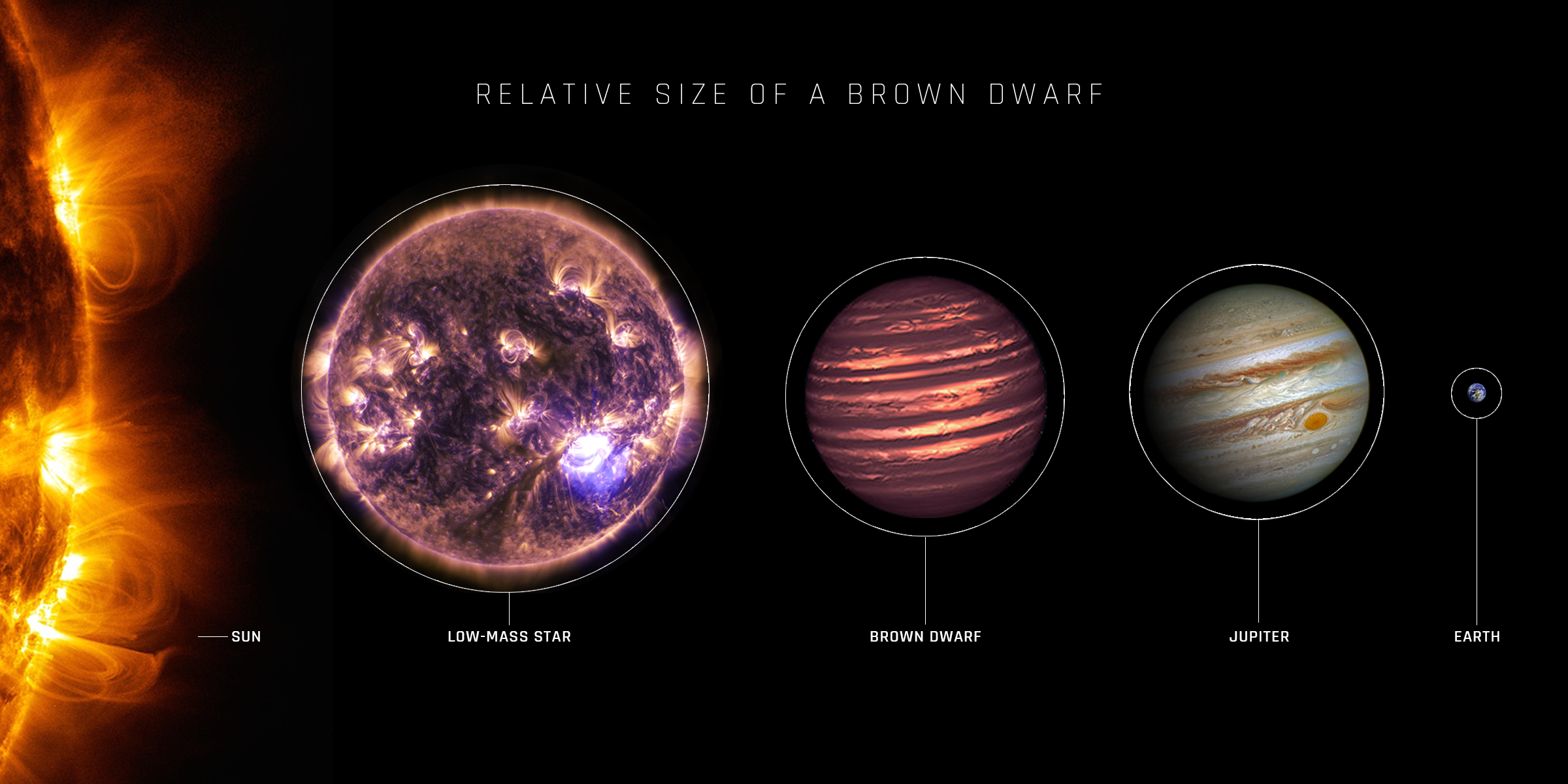
At the boundary between planets and stars lie objects whose nature has long been debated. 29 Cyg b — a companion to 29 Cygni with a mass of roughly 15 Jupiters — sits precisely at the deuterium-burning limit, where planets blur into brown dwarfs.
JWST's NIRCam coronagraph captured direct images of this object across 4–5 µm. The spectra reveal clear CO₂ and CO absorption, and the ratio between the two points to an atmospheric metallicity roughly three times solar. This heavy-element enrichment is the key: it matches formation within a protoplanetary disk through accretion of metal-rich material. CHARA/PAVO interferometry further confirmed that the companion's orbit aligns with the star's rotation axis — another hallmark of in-disk formation.
29 Cyg b is the first direct evidence that planet formation can reach masses at and beyond the deuterium-burning limit.