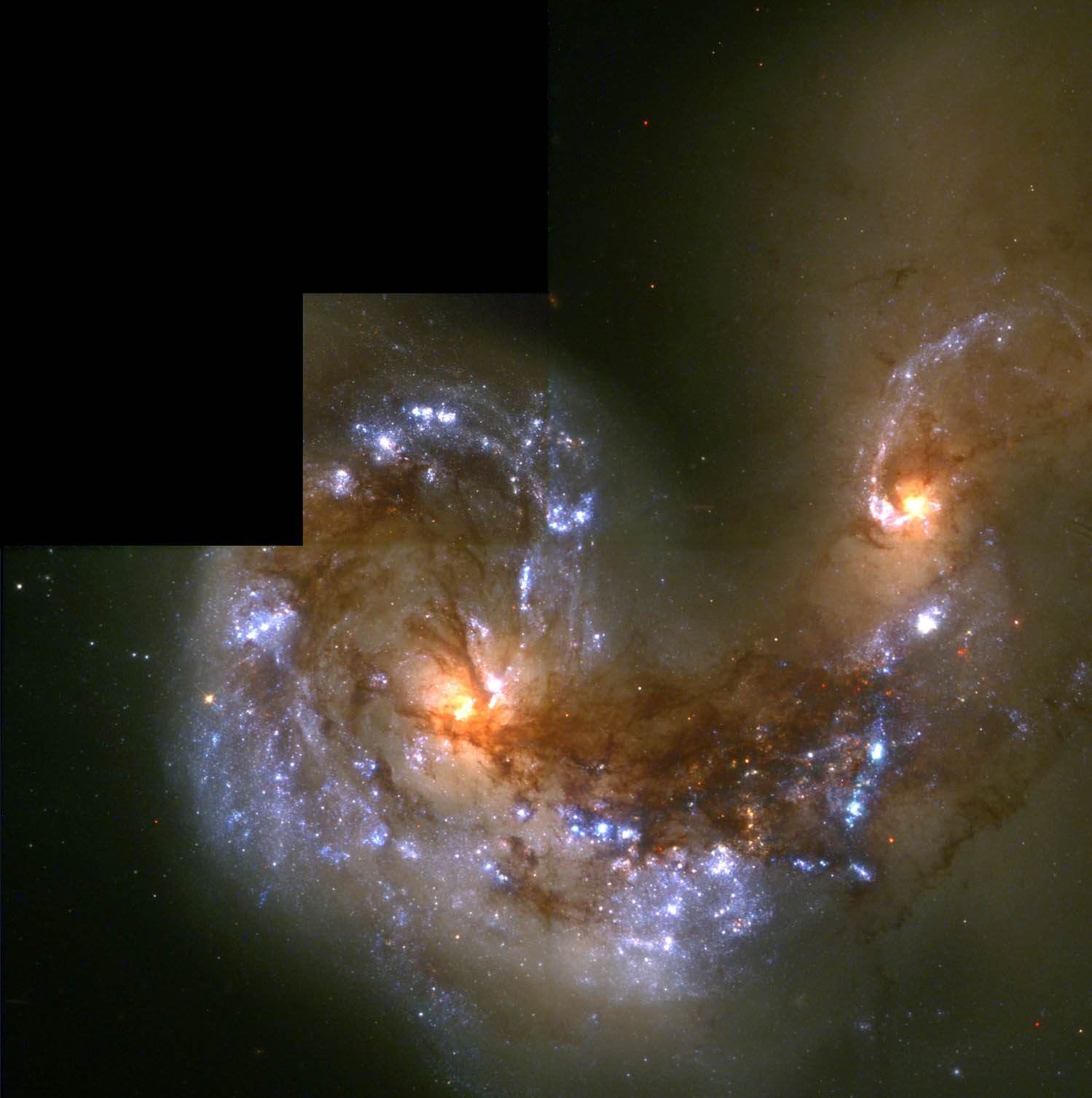
The Antennae galaxies — one of the most studied merging pairs in the sky — have long served as a natural laboratory for star formation under extreme conditions. Their overlap region produces super star clusters: stellar assemblies with masses of millions of suns, far denser than anything found in the Milky Way. What triggers their formation, however, has remained an open question.
A new study offers a compelling answer. Using ALMA at a resolution of roughly 14 parsecs, researchers resolved a super giant molecular cloud in the overlap region into two distinct gas components moving toward each other at a velocity difference of ~50 km/s. One forms a "U"-shaped structure inside a large filament, likely sculpted by ram pressure; the other displays hub-filament morphology — threads of gas converging toward a central point. This is precisely the geometry expected from a cloud-cloud collision.
At the apparent interface, ALMA detected 108 GHz continuum emission dominated by free-free radiation — the signature of ionized gas surrounding young, massive stars. The inferred ionizing photon rate matches the stellar mass and age of the optically identified super star clusters in the region. Infrared imaging from JWST adds the final piece: bright emission spatially coincident with the predicted collision zone.
Taken together, the multiwavelength evidence makes a strong case that cloud-cloud collisions are a key driver of super star cluster formation in merging galaxies — not merely a theoretical possibility, but an observed process caught in the act.