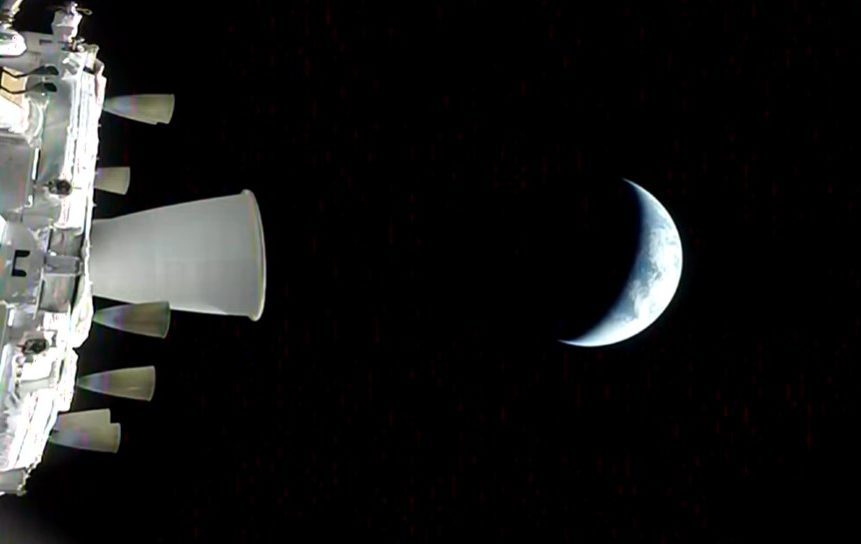
1️⃣ For the first time in 52 years: humans are flying to the Moon
On April 1, 2026, NASA launched Artemis II — the first crewed lunar mission since Apollo 17 in 1972. Aboard Orion ("Integrity") are four astronauts: Reid Wiseman, Victor Glover, Christina Koch, and Canadian Jeremy Hansen. On April 2, a translunar injection burn sent the crew beyond Earth orbit — the farthest humans have traveled in over half a century. A lunar flyby is scheduled for April 6, with splashdown in the Pacific around April 10.
🔗 Source
2️⃣ JWST peers into the heart of star-forming region W51A
James Webb captured images of W51A in 10 NIRCam and 5 MIRI filters, covering a 4×8 parsec area that is one of the most active stellar nurseries in the Galaxy. The images reveal dust filaments geometrically converging onto protocluster W51-E, while a cavity around neighboring W51-IRS2 suggests its own feedback has already halted further gas infall. A compact knot of [Fe II] and H₂ emission north of W51-IRS2 stands out in all JWST bands — likely the most energetic known protostellar jet impacting dense interstellar medium.
🔗 Source
3️⃣ How binary stars form — even next to giants
The DIHCA survey with ALMA found 72 low-mass multiple systems embedded within 23 high-mass cluster-forming regions. The peak companion separation here is ~1200 AU — two to three times smaller than in quieter, low-mass star-forming clouds — a consequence of higher pressure and turbulence compressing cloud fragments more tightly. Interestingly, the multiplicity fraction stays constant regardless of stellar density, suggesting that dynamic interactions simply disrupt weakly bound pairs before they can be observed.
🔗 Source
4️⃣ A maser in NGC 1365 pinpoints bar-driven shocks
Astronomers detected the first extragalactic Class I methanol maser at 36.2 GHz in the barred spiral galaxy NGC 1365 — the most luminous of its kind known, at 19.3 L☉. The emission is precisely localized to the southern arm of the circumnuclear starburst ring, where bar-driven gas inflow collides with the ring at ~25–30 km/s in low-velocity, nondissociative shocks. This maser provides the first clean observational tool to distinguish gravitational bar dynamics from stellar feedback within galactic nuclei.
🔗 Source
5️⃣ Three thousand new solar neighbors — found by volunteers
The Backyard Worlds: Planet 9 project presents a catalog of 3,006 new L and T dwarf candidates, all identified by their motion across WISE images by citizen scientists. Spectroscopic follow-up has yet to confirm their nature, but if confirmed, this single sample would more than double the number of known L and T dwarfs. Among them: 28 new comoving companions to higher-mass stars and 9 candidate ultracool binary systems. A result no automated pipeline could have achieved without hundreds of thousands of human eyes.
🔗 Source