When a star far more massive than the Sun reaches the end of its life, its iron core — the final product of millions of years of nuclear fusion — collapses in a fraction of a second. The outer layers crash inward and rebound off the newly formed dense core, and that rebound is the supernova explosion. What remains: a ball roughly 20 kilometers across, yet containing several times the mass of the Sun. This is, perhaps, the most extreme object in the Universe — a neutron star.
The core's mass wasn't enough to cross the Oppenheimer-Volkoff limit and collapse into a black hole — but the pressure inside is so immense that electrons are literally forced into protons, forming neutrons. Hence the name. A teaspoon of neutron star material would weigh a billion tons.
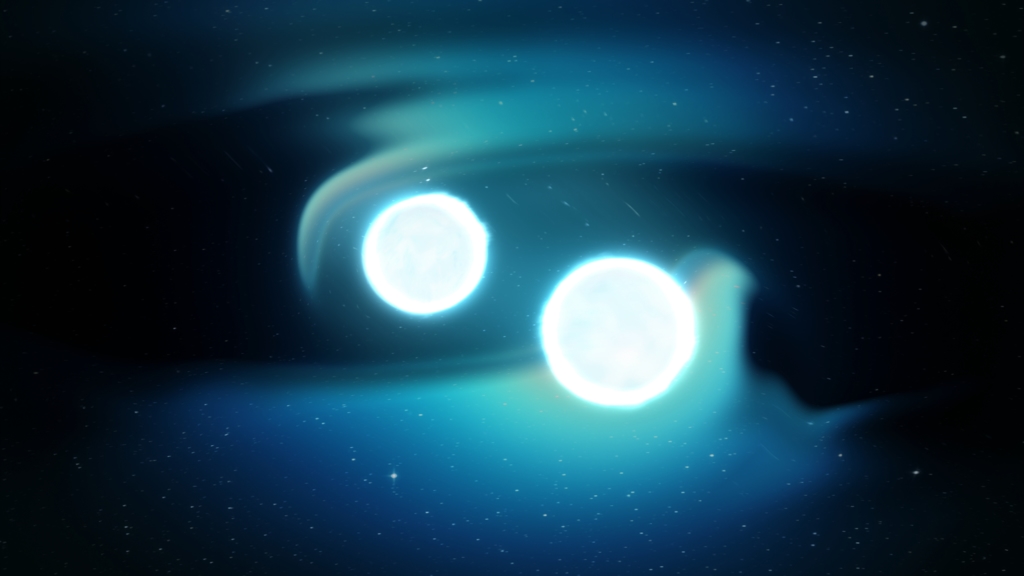
If two neutron stars find themselves in a binary system, they spiral toward each other for billions of years before merging in a single catastrophic collision. It is precisely in these catastrophes that the heaviest elements are forged — gold, platinum, uranium. The gold in any piece of jewelry is the product of two neutron stars colliding billions of years ago.