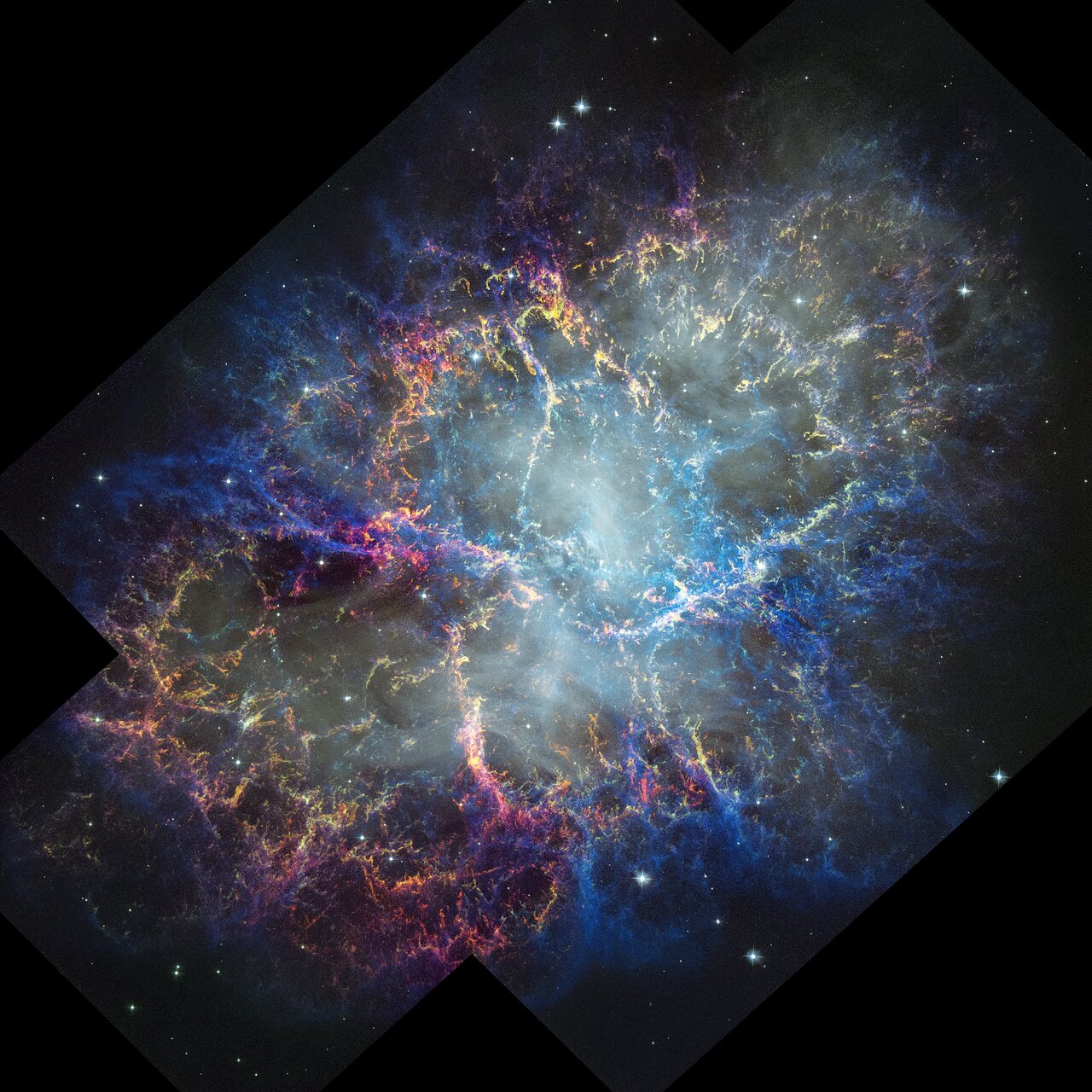
Nearly a thousand years ago, Chinese astronomers recorded the appearance of a new star — brilliant enough to be seen in daylight for weeks. What remained from that explosion is the Crab Nebula: the expanding remnant of supernova SN 1054, located 6,500 light-years away in Taurus. The Hubble Space Telescope has just returned to this object for the first time in 25 years, capturing how it continues to evolve.
The new images reveal the motion of the nebula's filamentary structure in striking detail. The outermost filaments are moving outward at roughly 5.5 million kilometres per hour — and rather than stretching over time, they appear to travel as a coherent whole. This behavior is specific to pulsar wind nebulae: unlike most supernova remnants, where expansion is driven by the shockwave from the initial explosion, the Crab is powered by synchrotron radiation generated by the interaction between the central pulsar's magnetic field and the surrounding material.
The higher-resolution data also shed new light on the nebula's three-dimensional structure. Shadows of some filaments are visible against the glow of synchrotron radiation in the interior. Paradoxically, some of the brightest filaments cast no shadows at all — indicating they lie on the far side of the nebula, beyond the illuminated region.
The full scientific value of these observations is still ahead. The Hubble data can now be combined with Webb's 2023 infrared images and multiwavelength observations from other facilities — together building the most complete picture yet of a stellar catastrophe that began nearly a millennium ago and is still unfolding today.
The study is published in The Astrophysical Journal.