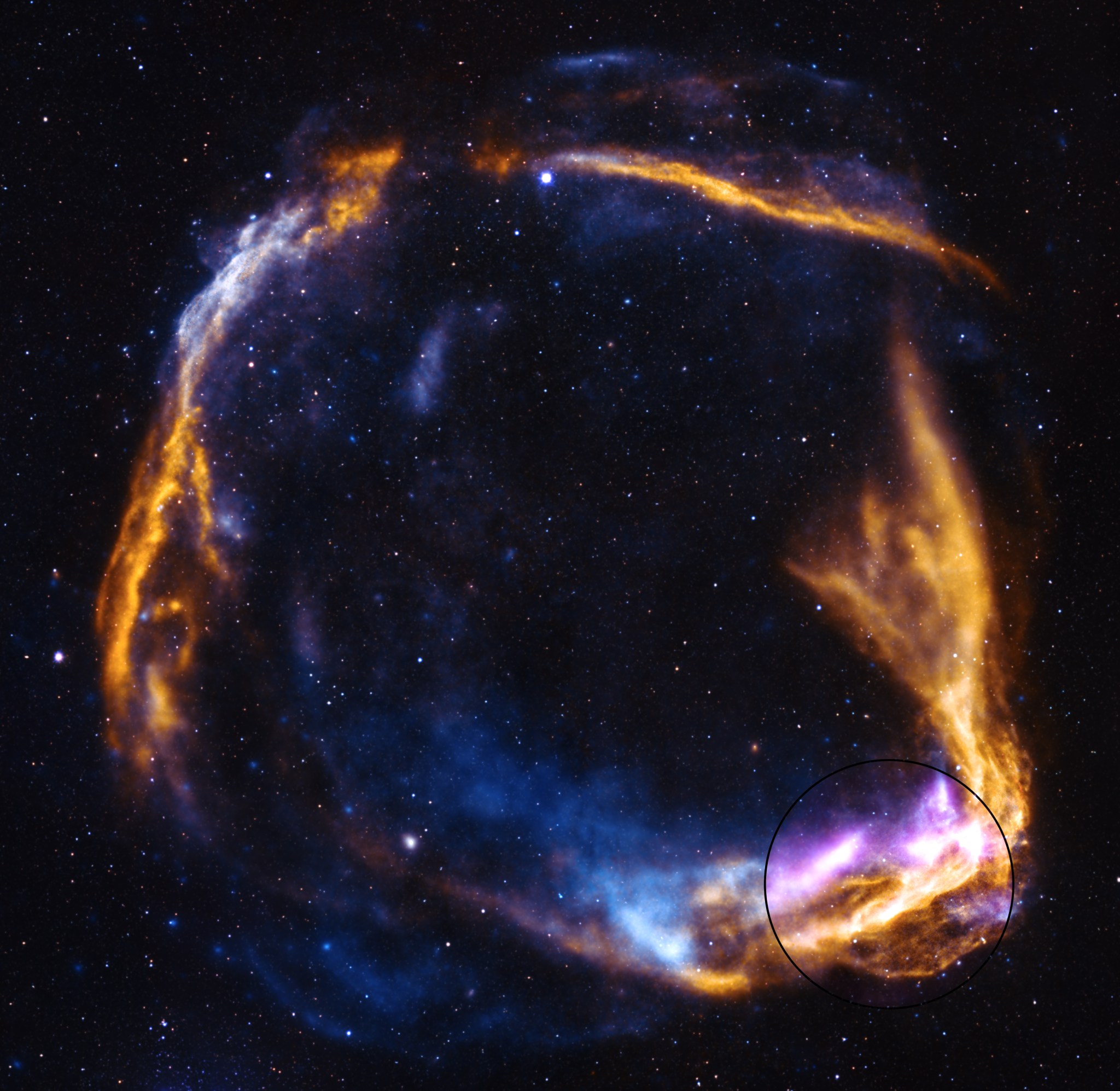
About 2,000 years ago, people on Earth watched a new star appear in the sky. The remnant of that explosion, RCW 86, is still evolving — and NASA's IXPE (Imaging X-ray Polarimetry Explorer) has now captured fresh X-ray observations of its outer rim, adding new detail to what the Chandra X-ray Observatory revealed years earlier.
Chandra had previously found a large low-density cavity surrounding the system — one that allowed the remnant to expand faster than expected and likely gave it its unusual shape. IXPE now shows where that expansion appears to have stalled at the cavity's edge, producing a reflected shock wave, visible as the purple arc in the combined image. Yellow in the image represents low-energy X-rays; blue marks the high-energy X-rays from Chandra and XMM-Newton.
IXPE is a joint mission between NASA and the Italian Space Agency, built around X-ray polarimetry — a tool that keeps rewriting our understanding of the universe's most extreme objects.