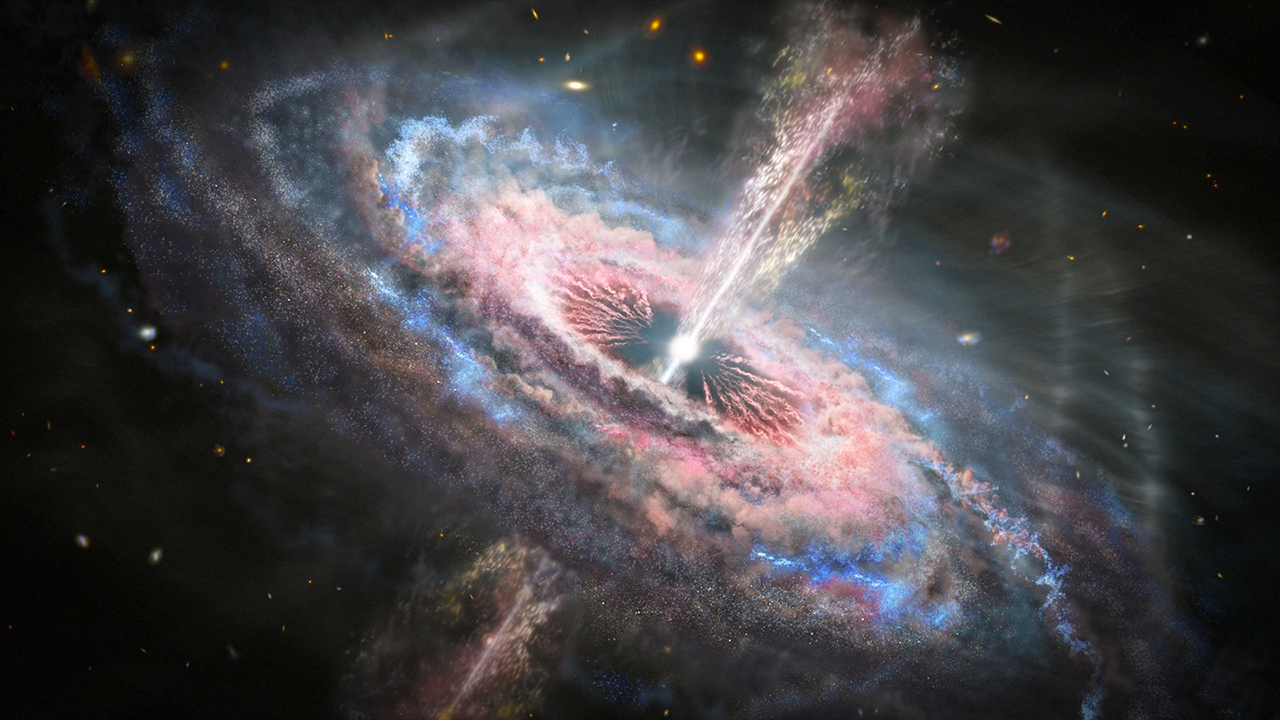
Quasars are the most extraordinary objects in the Universe — cosmic monsters that devour matter and convert it into the most powerful radiation known to science.
At the heart of every quasar sits a supermassive black hole consuming surrounding material at a staggering rate. A swirling accretion disk of superheated plasma forms around it, radiating so much energy that it outshines hundreds of billions of stars combined. The brightest known quasar — J0529-4351 — is over 500 trillion times more luminous than the Sun.
This extraordinary brilliance makes quasars visible across the entire observable Universe. The most distant ones we see as they were less than a billion years after the Big Bang — their light has traveled 13 billion years to reach us, and still arrived.
But the most fearsome feature of quasars is their jets. Some black holes launch narrow beams of plasma accelerated to nearly the speed of light, stretching hundreds of thousands of light-years beyond their host galaxy. Where these jets collide with neighboring dwarf galaxies, they heat and disperse all the gas within — permanently stripping those galaxies of the raw material needed to form new stars.
Quasars are not simply bright points of light. They are the most powerful engines in the known Universe, shaping the space around them across colossal distances. And that is why they are called the lighthouses of the cosmos — their light crosses billions of light-years to tell us what the Universe looked like at the very beginning.