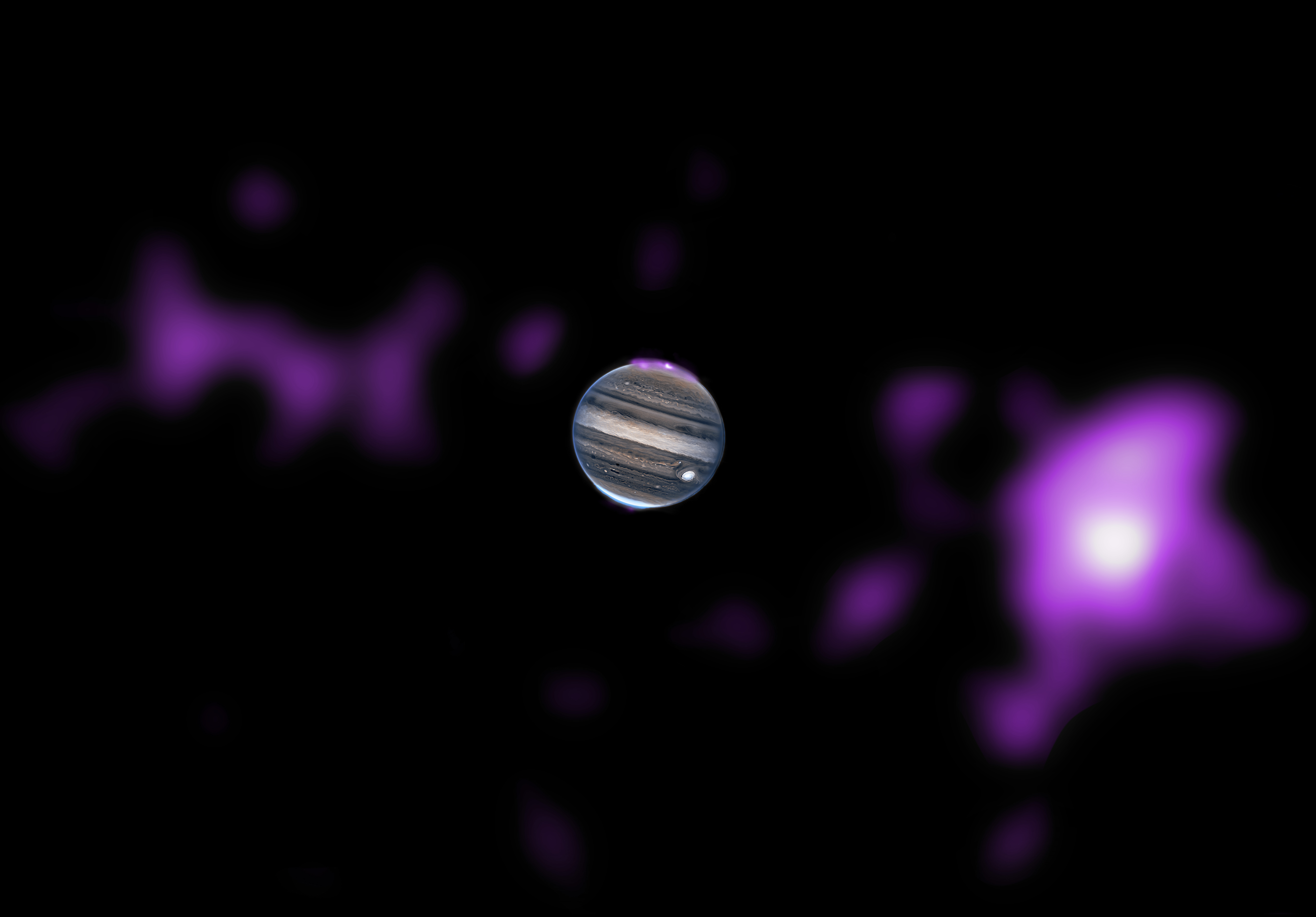
In late February, skywatchers in the Northern Hemisphere can spot six planets visible to the naked eye at once. To mark the occasion, NASA's Chandra X-ray Observatory released new sonifications — converting telescope data into sound — letting audiences hear Jupiter, Saturn, and Uranus in ways impossible from Earth.
Sonification works by scanning an image with an activation line, translating visual elements like brightness, position, and emission type into corresponding sounds.
Jupiter is represented by woodwind instruments carrying X-ray data from the ring of energetic particles surrounding the planet and its auroras. Infrared cloud layers add texture, and the Great Red Spot registers as a distinct drop in pitch.
Saturn opens with a siren-like tone that traces the arc of its iconic rings. A deep synthetic bass distinguishes the planet's body, while higher synthesizer tones mark regions of elevated X-ray activity detected by Chandra.
Uranus is introduced by a sweeping cello note that follows the shape of the ice giant's narrow rings. Reflected solar X-rays — the source of Chandra's signal here — appear as higher frequencies over the planet's pinkish region.
Chandra is best known for studying black holes and extreme cosmic objects, but it has long contributed to solar system science. Planets reflect X-rays from the Sun, giving astronomers a unique observational window unavailable through optical or infrared telescopes.