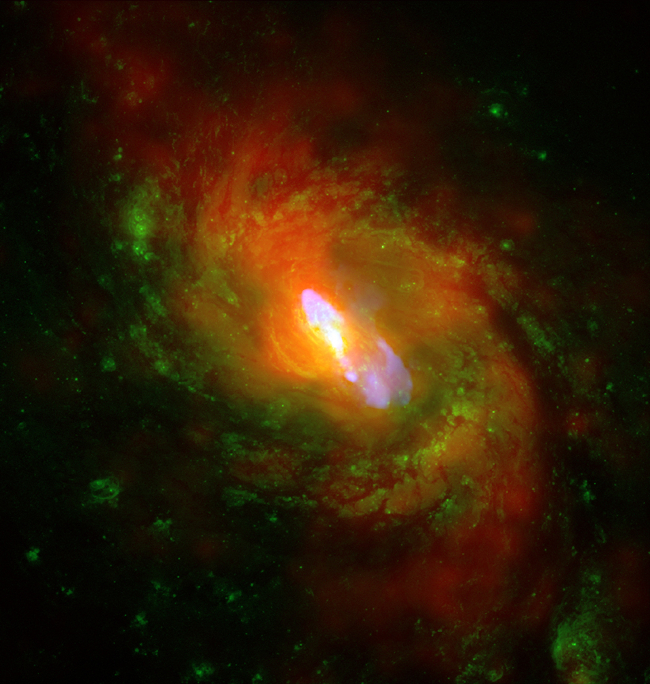
In 2022, IceCube reported evidence for high-energy neutrinos from the active galaxy NGC 1068 — a Seyfert galaxy whose supermassive black hole consumes surrounding matter without a powerful directed jet. X-ray emission is the key diagnostic here: it can penetrate the opaque cores where particles are accelerated and neutrinos are produced.
A new IceCube study extends the search from a single source to a systematic survey of the Southern Hemisphere, where the detector is traditionally less sensitive. The ESTES method — selecting neutrino events that originate within the detector — suppressed atmospheric backgrounds and enabled analysis of 10 years of data toward 14 X-ray bright Seyfert galaxies from the Swift BAT AGN Spectroscopic Survey.
The result: a collective neutrino signal from 13 sources exceeds background at 3.0σ significance. NGC 1068 leads, but other galaxies contribute measurably — consistent with theoretical models linking neutrino flux to AGN X-ray luminosity. IceCube-Gen2 will sharpen this picture considerably.