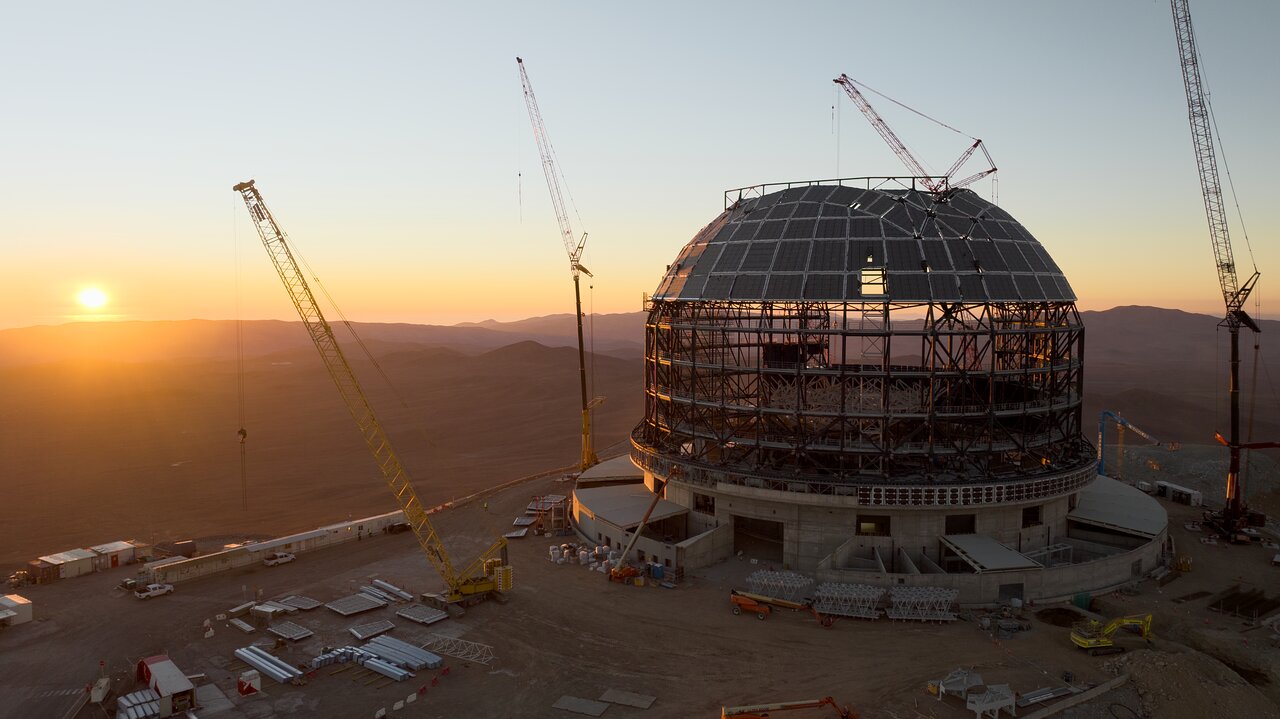
The Extremely Large Telescope is still under construction on a mountaintop in Chile's Atacama Desert. Its dome is nearly complete, technical first light is planned for 2029, and first scientific observations for 2030. Yet astronomers are already thinking beyond that: the ELTI concept proposes equipping the ELT with a visible-light interferometer that would push its capabilities into entirely new territory — and it's designed for the 2040s.
ELTI combines the ELT's enormous collecting area with intensity interferometry, megapixel SPAD detector arrays with picosecond time resolution, and high-dispersion spectroscopy. Together, these deliver milliarcsecond angular resolution — a level no current instrument can reach.
The science targets are ambitious: direct imaging of stellar surfaces, studies of accretion physics around black holes and neutron stars in extreme-gravity environments, and the potential detection of Earth-sized exoplanets through minute brightness variations. The ELT is still being built — and its next-generation instruments are already being designed.