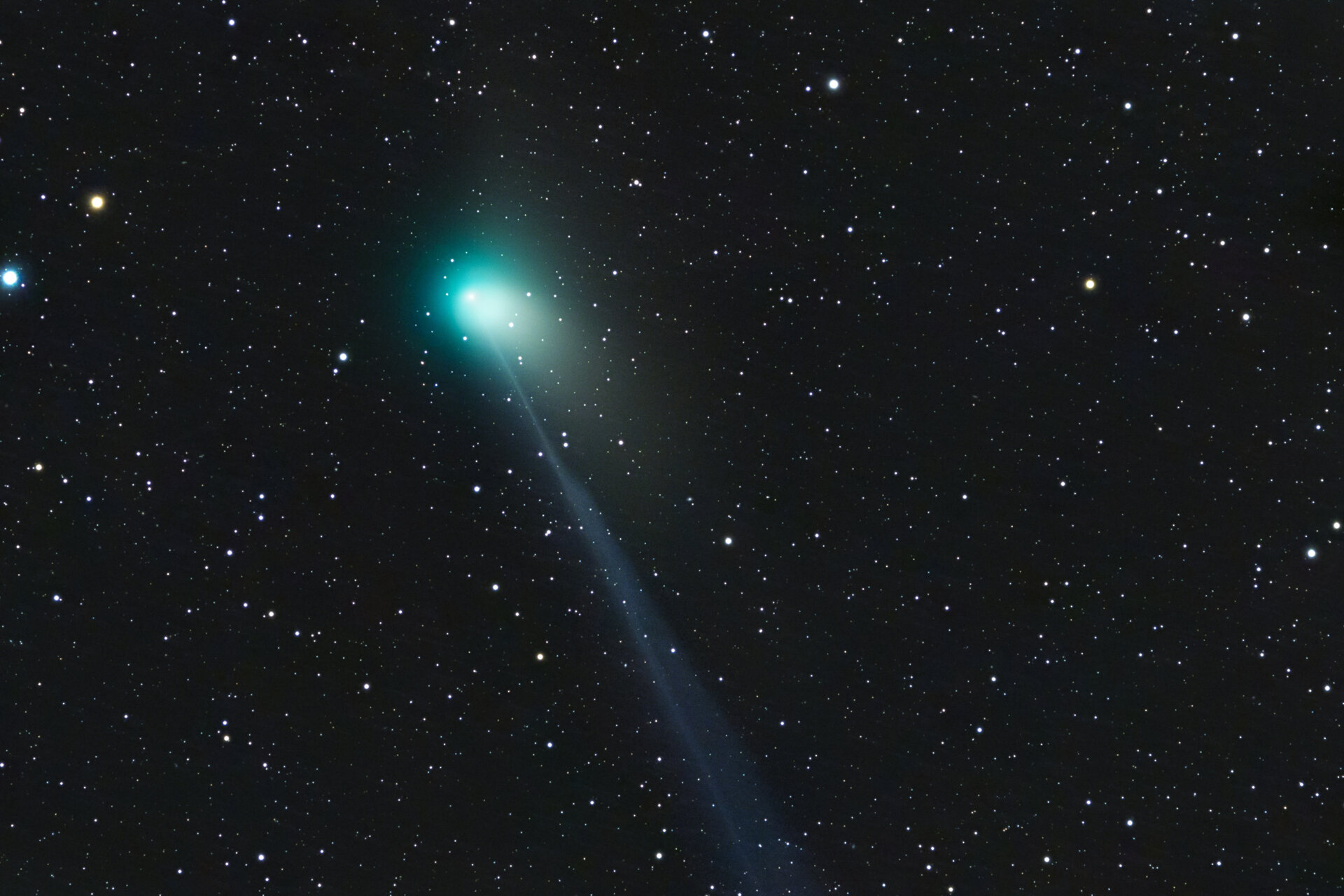
In March 2023, astronomers trained two of the most powerful instruments in modern astronomy on a single target — long-period comet C/2022 E3 (ZTF). JWST and the ALMA radio observatory simultaneously analyzed the chemical composition of its coma, and the results turned out to be remarkably consistent.
The primary focus was water (H₂O) and methanol (CH₃OH) — molecules found both in comets and in the protoplanetary disks where star systems form. That's why comets are often called time capsules: they preserve material left over from the birth of the solar system largely unchanged.
Modeling showed that the distribution of molecules in the coma is mostly concentrated near the nucleus. One detail stands out, though: in the antisunward direction, the rotational temperature of the molecules is statistically elevated — possibly reflecting how solar wind and radiation interact with the comet's tail.
JWST also captured how water molecule temperatures drop with increasing distance from the nucleus. This is explained primarily by rotational line cooling — the molecules losing energy through their own emission rather than simply dispersing into space. Values derived independently by both telescopes agreed within measurement uncertainties, a rare cross-validation between such fundamentally different instruments.