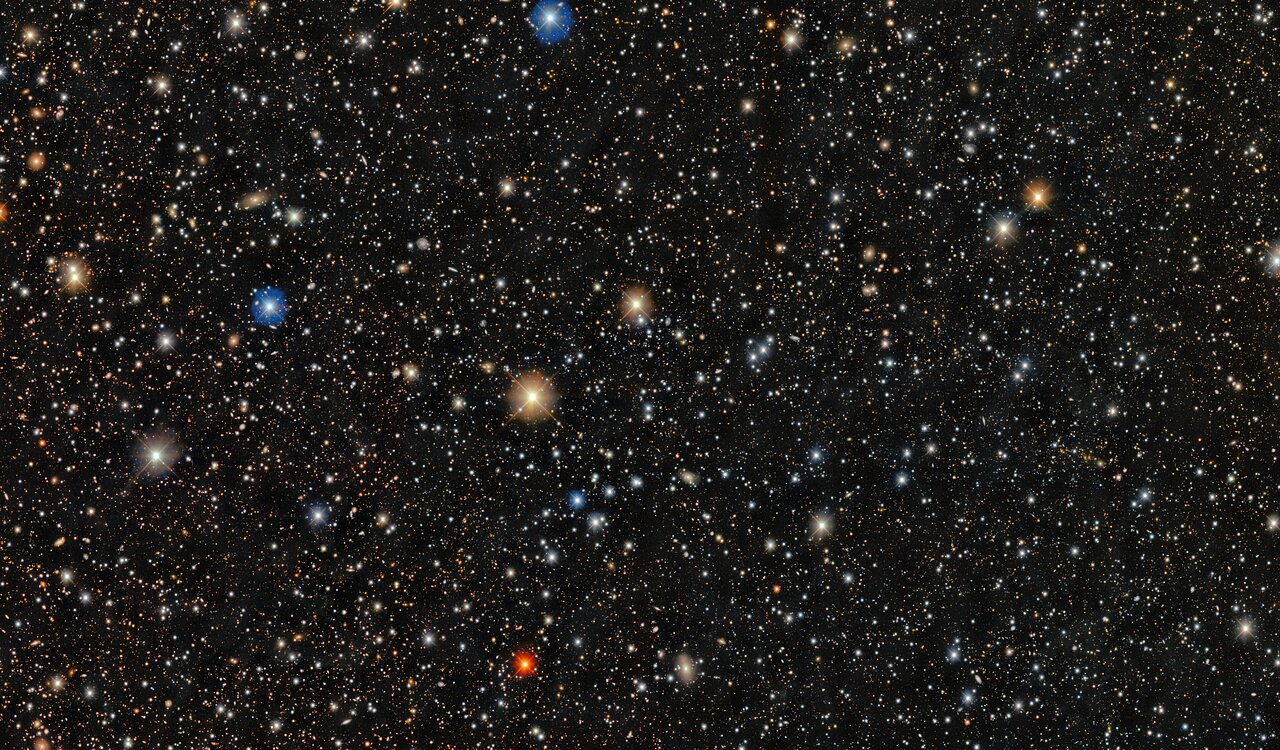
Astronomers have identified PicII-503, a star in the ultra-faint dwarf galaxy Pictor II, as the clearest example yet of second-generation star formation — one that formed directly from material ejected by the Universe's very first stars. Its iron abundance is more than 40,000 times lower than the Sun's, while its carbon-to-iron ratio exceeds the Sun's by a factor of 1,500. No star outside the Milky Way has ever been measured with lower iron or calcium content.
The first stars formed from pure hydrogen and helium, synthesized heavier elements in their cores, then scattered them across the interstellar medium in supernova explosions. Second-generation stars that captured this material are, in effect, chemical time capsules — but finding one in an intact primordial environment has remained elusive until now. PicII-503 was isolated from hundreds of neighboring stars using the DECam MAGIC survey's narrow-band calcium filter, then confirmed with the Magellan and Very Large Telescopes.
The extreme carbon overabundance points to a low-energy supernova mechanism, where iron-rich material near the stellar core fell back into the compact remnant while lighter elements like carbon were expelled. The fact that PicII-503 remained bound to the gravitationally weak Pictor II galaxy supports this: a high-energy explosion would have driven the metals out entirely. The finding also resolves a long-standing mystery — carbon-enhanced metal-poor stars scattered through the Milky Way halo likely originated in ancient dwarf galaxies like Pictor II that merged with ours billions of years ago.