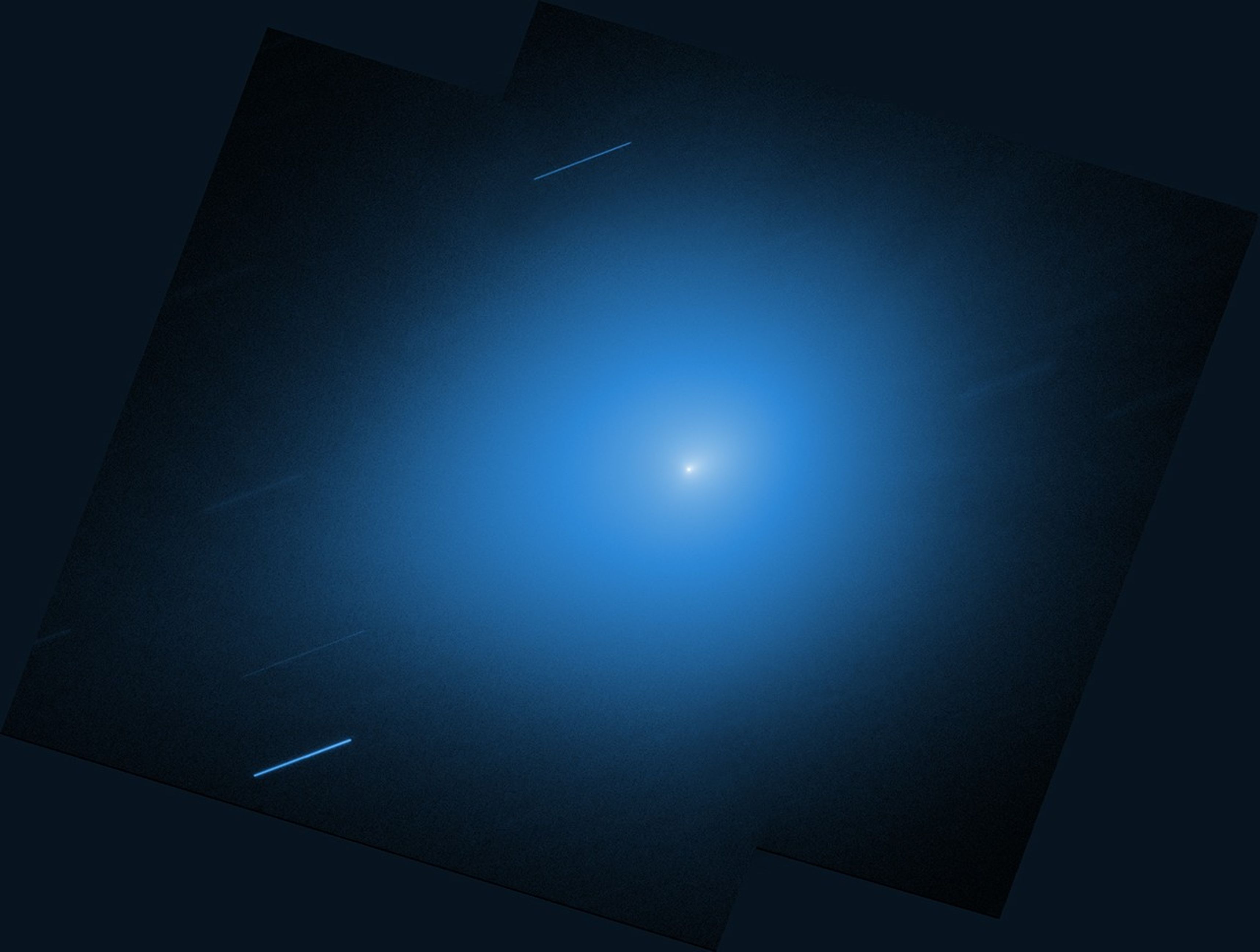
On July 1, 2025, a ground-based ATLAS telescope in Chile detected something unusual: a bright object moving through the solar system on a trajectory that could not belong to any known comet or asteroid. This was humanity's introduction to 3I/ATLAS — only the third interstellar object ever identified in our solar system.
But the comet had already been captured on camera weeks earlier. A search through NASA's public archives revealed that TESS — the space telescope built to hunt exoplanets — had imaged 3I/ATLAS back in May 2025, two months before its official discovery. Its wide field of view caught the visitor by chance, and those early frames allowed astronomers to reconstruct the comet's trajectory through the solar system with far greater precision.
Its chemistry turned out to be just as surprising. Solar system comets have well-understood ratios of water, carbon dioxide, and carbon monoxide. In 3I/ATLAS, those ratios were different — and determining this required combining data from multiple missions simultaneously: spectral observations from the MAVEN Mars orbiter, infrared data from James Webb Space Telescope, and the recently launched SPHEREx. The PUNCH mission — four small satellites designed to study the solar wind — also managed to capture the comet in late 2025 through careful image stacking.
More than a dozen NASA missions turned their instruments toward a single target. This was only possible because NASA has spent decades building an open science infrastructure: unified data formats through the Planetary Data System, public archives like MAST and IRSA, freely accessible to anyone. That foundation is what allowed researchers to quickly combine data across instruments and reach conclusions no single mission could have achieved alone.
3I/ATLAS is now leaving the solar system and will never return. But the data will remain. Scientists estimate interstellar objects may pass through our solar system roughly once per year — most simply went undetected before the telescopes existed to find them. As instruments improve, such discoveries will become routine, and future astronomers will compare each new visitor against 3I/ATLAS: the first interstellar comet humanity ever truly studied.
"Thirty-five years from now, astronomers will be asking different questions," said Thomas Statler of NASA. "The way we leave a legacy so scientists of the future can answer those questions is by having this data preserved and available for them." Sonnet 4.6Extended